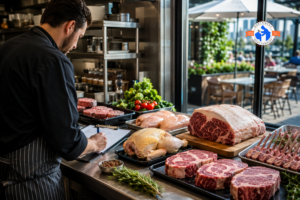
A case arrives at the restaurant with a clear price attached to it, which makes the purchasing decision appear straightforward, because one supplier offers the product for less, another charges more, and the difference seems easy to measure.
Yet the number printed on the invoice tells only what the restaurant paid to receive the product, not what it ultimately costs to prepare, portion, cook, and place that product in front of a guest.
Between the receiving dock and the dining room, weight disappears through trimming, moisture is lost during cooking, labor is invested in preparation, and inconsistent portions quietly alter the economics of every plate. A protein that appears inexpensive by the pound can become significantly more expensive once those losses are calculated, while a higher-priced product with better specifications, stronger yield, and more predictable performance can deliver the lower true cost.
The question, therefore, is not simply, “How much does this case cost?”
The more valuable question is, “How many consistent, sellable portions will this case produce?”
A Lower Case Price Can Create a Higher Plate Cost
Case price matters because every restaurant must protect its purchasing budget, but purchasing price and usable cost are not the same measurement.
A restaurant does not generate revenue from every pound that enters the building. It generates revenue from the portion that survives trimming and preparation, performs predictably during cooking, and reaches the guest at the intended size and quality.
If a lower-priced beef cut requires extensive trimming, loses more moisture on the grill, and produces inconsistent portions, the savings recorded during purchasing can disappear before service begins. If poultry arrives with irregular sizing that requires additional handling, or if a roast varies significantly from one delivery to the next, the kitchen absorbs the difference through labor, waste, and inconsistent plate costs.
The least expensive case is not always the product with the lowest cost.
Sometimes, it is simply the product whose additional costs have not yet been measured.
Understanding the Difference Between Purchased Weight and Usable Yield
Restaurants purchase proteins by weight, but they sell them by usable portion, and the distance between those two measurements is where profitability is either protected or lost.
The weight printed on the case is commonly understood as the as-purchased weight, which represents everything received before trimming, fabrication, and cooking. The edible or usable portion is what remains after the product has been prepared and is ready to generate revenue.
Consider a whole beef tenderloin. The restaurant pays for the full tenderloin, including fat, silverskin, chain meat, and other material that may need to be removed before filet portions can be cut. Some of that trim may be repurposed, but not all of it will carry the same menu value as a center-cut filet.
The same principle applies to brisket, pork shoulder, chicken, lamb, and nearly every other protein category. Bones, excess fat, uneven edges, damaged portions, and moisture loss all affect how much of the purchased product can ultimately be sold.
Usable yield reveals what the invoice cannot, because it connects the product entering the kitchen with the portions leaving it.
Trim Loss: Paying for Weight That Never Reaches the Plate
Trim loss begins before the protein reaches the cooking surface, and although it can appear minor when viewed one cut at a time, its financial impact becomes significant across hundreds or thousands of portions.
A poorly specified cut may require the kitchen team to remove excessive fat, connective tissue, uneven edges, or other material before cooking. Every ounce removed represents weight the restaurant purchased but may not be able to sell at the intended menu price.
Trim can sometimes be cross-utilized in stocks, sauces, ground preparations, or staff meals, but repurposing does not automatically restore its original value. A pound purchased to produce a premium steak does not deliver the same return when redirected into a lower-priced secondary application.
This is why cut specifications matter. A carefully fabricated product with consistent trimming may carry a higher initial price, but it can reduce waste, simplify preparation, and produce more predictable portions from every case.
The value is not found only in what arrives.
It is found in how little must be removed before the product can begin earning revenue.
Cooking Loss: What Remains After Heat Does Its Work
Even after trimming is complete, the protein continues to lose weight during cooking as moisture and fat render away.
Cooking loss varies according to the cut, fat content, preparation method, target temperature, equipment, resting practices, and skill of the kitchen team. Two proteins with the same purchased weight can produce very different finished yields depending on how they respond to heat.
A roast that loses excessive moisture may require a larger raw portion to deliver the intended cooked serving. A burger blend with inconsistent fat content may create unpredictable shrinkage. Chicken breasts that vary significantly in thickness can cook unevenly, leaving some portions dry while others require additional time.
These inconsistencies create costs beyond the missing weight. They affect ticket times, holding performance, presentation, guest satisfaction, and the kitchen’s ability to reproduce the same plate throughout service.
Strong cooking yield does not mean selecting the product that loses the least weight under every circumstance. It means selecting proteins whose performance is understood, appropriate for the application, and consistent enough to support reliable planning.
When chefs know how a product will behave, they can calculate portions accurately, schedule preparation intelligently, and price the menu with greater confidence.
Portion Consistency Protects More Than Presentation
Portion consistency is often discussed as a matter of visual presentation, but its financial importance reaches far beyond appearance.
When a menu promises an eight-ounce steak, every portion should remain close to that specification. If the kitchen regularly serves nine ounces instead, the additional ounce may feel insignificant during a single service, but multiplied across hundreds of plates, it becomes a substantial amount of uncharged product.
Underportioning creates a different problem, because guests notice when a dish fails to meet expectations, especially when they have ordered the same item before. Inconsistent portions weaken trust, complicate food-cost calculations, and make it difficult for operators to understand whether a menu item is performing as planned.
Pre-portioned or cut-to-spec proteins can reduce this variability by giving the kitchen a dependable starting point. They support more accurate plate costing, faster preparation, consistent cooking times, and a more uniform guest experience.
Precision protects the restaurant twice: first by controlling how much product is used, and again by ensuring that every guest receives the plate the menu promised.
Labor Belongs in the Yield Conversation
A lower-priced product may arrive with more fabrication work attached to it, which means the restaurant has not eliminated the cost; it has simply transferred part of it from purchasing to the kitchen.
Every minute spent trimming, weighing, cutting, repackaging, and correcting irregular portions carries a labor cost. During a quiet preparation period, that cost may appear manageable, but in an understaffed kitchen or during a high-volume week, additional fabrication can pull skilled employees away from other essential work.
Labor requirements also affect consistency. The more steps a product requires, the more opportunities there are for variation between employees, shifts, and service periods. One cook may trim aggressively, another may leave excess fat, and a third may cut portions at slightly different weights.
Restaurant-ready proteins and custom specifications can reduce those variables. The value is not simply convenience; it is the ability to move labor toward preparation, execution, and service rather than using skilled kitchen hours to correct the product before it becomes usable.
A complete yield calculation must therefore account for more than product weight, because time is also consumed between the case and the plate.
A Simple Comparison Reveals the Real Cost
Imagine that a restaurant is comparing two cases of the same general protein application.
The first product costs $6 per pound, while the second costs $7 per pound. Viewed only through the invoice, the first option appears to offer a clear advantage.
However, if the lower-priced product loses 20 percent of its weight during trimming and another 25 percent during cooking, an 80-pound case produces approximately 48 pounds of usable product. At a total case cost of $480, the restaurant is paying about $10 for every usable pound before preparation labor is included.
If the higher-priced product loses only 8 percent during trimming and 18 percent during cooking, the same 80-pound case produces slightly more than 60 pounds of usable product. Although the case costs $560, the usable product costs approximately $9.28 per pound before labor.
The more expensive case has become the less expensive ingredient.
This example is intentionally simplified, because actual yields differ according to the product and preparation method, but it illustrates why case-price comparisons can be misleading. Once trim, cooking loss, and usable portions are calculated, the purchasing decision may look entirely different.
Why Supplier Consistency Becomes a Financial Advantage
Yield calculations are only useful when the product performs consistently from one delivery to the next.
If trim levels, portion sizes, fat distribution, or case weights vary repeatedly, chefs cannot forecast usable yield with confidence. Food-cost projections become less reliable, preparation times shift, and the kitchen must continually adjust to a product that behaves differently each week.
A dependable supplier helps reduce that uncertainty through clear specifications, experienced fabrication, consistent sourcing, and communication about the needs of each operation. The objective is not simply to deliver protein, but to deliver a product that fits the menu, equipment, labor model, and service volume of the restaurant receiving it.
NorthWest Meat Company works with Chicago chefs and foodservice operators to identify the specifications behind stronger yield, whether that means custom-cut portions, more consistent sizing, preparation suited to the intended cooking method, or dependable ordering support.
Since 1956, that work has been grounded in a practical understanding of professional kitchens: consistency is not an abstract promise when every ounce affects the plate.
Measure What Reaches the Guest
The case price will always remain part of the purchasing decision, but it should never be allowed to make that decision alone.
Restaurants must evaluate what survives trimming, how the protein performs during cooking, how accurately it can be portioned, how much labor it requires, and how many consistent plates the case can ultimately produce.
The strongest purchasing decisions are not built around the lowest number on an invoice. They are built around the clearest understanding of value from receiving through service.
Because restaurants do not earn revenue from the weight they purchase.
They earn it from the portions they can serve.
Connect with our team to review your current protein program and identify opportunities to improve yield, control costs, and create greater consistency across every service.